The user sees the error code before they see your logo. They typed the URL correctly, or at least they think they did, and the browser returned a blank white screen with a small, unhelpful number: 404. Most companies treat this moment as a failure state. They build a page that says “Page Not Found” and offer a single link back to the homepage. That is a $404 error page that costs you exactly what that visitor was worth to you.
When a user lands on a broken link, they are not browsing aimlessly. They arrived from a specific source, a Google search, a LinkedIn post, a newsletter, or a direct share from a colleague. They have a specific intent. They are looking for a solution to a problem, and your site failed them. The question is not how to hide the error. The question is how to monetize the mistake.
A properly engineered 404 page is not a dead end. It is a high-intent landing page that happens to be triggered by a failure. If you treat it as a conversion opportunity, you can recover 15 to 30 percent of the traffic that currently bounces. That is not a theoretical metric. It is a direct reflection of how many people are willing to keep looking for what they came for, provided you give them a path that respects their original intent.
Why Your Current 404 Page Is Wasting Money
Most 404 pages are built by developers who view them as an afterthought. The standard template includes a generic illustration, a brief apology, and a button that takes the user back to the homepage. This design assumes the user wants to start over. It assumes they will remember what they were looking for, navigate the entire site structure, and find the content again. That assumption is statistically false.
When a user hits a 404, they experience a micro-friction event. Their brain registers a mismatch between expectation and reality. If you force them to the homepage, you are increasing that friction. You are asking them to restart the cognitive load of finding your product. Most will not. They will close the tab and go to your competitor.
The cost of a bounced 404 visitor is not zero. It is the full cost of the acquisition channel that brought them there. If you paid $5 per click on Google Ads to get that user to your site, and they leave because of a broken link, you just burned $5 for nothing. If they came from an organic search result, you burned months of SEO effort. The 404 page is the leak in your funnel, and most companies are using a sponge to plug it instead of a patch.
The Intent-Matching Principle
The single most effective change you can make to a 404 page is to match the intent of the broken link. This is not about guessing what the user might want. It is about analyzing the URL they just tried to visit and serving content that aligns with that specific request.
Consider a user who types in /pricing/enterprise and receives a 404. They are clearly in the consideration phase of the buyer journey. They are comparing enterprise plans. If your 404 page sends them to the homepage, they have to hunt for pricing again. If your 404 page detects the keyword “enterprise” in the broken URL and immediately displays a comparison table of your top three enterprise competitors, you have turned a failure into a sales asset. You are acknowledging their intent and providing a relevant alternative. This approach mirrors the strategy detailed in Raise Prices Without Losing Customers: The Anchoring Playbook Small Teams Miss, where leveraging psychological cues like pricing structure can guide user behavior without triggering resistance.
This requires a simple technical implementation. Your server must parse the requested URL, extract keywords, and map them to your most relevant content. If the URL contains “blog,” show your latest three posts. If it contains “pricing,” show your pricing page. If it contains a product name, show that product’s documentation or a demo request form. This is not complex engineering. It is basic server-side logic that any modern framework supports.
The goal is to reduce the cognitive distance between the error and the solution. Every click you remove increases the likelihood of conversion. A user who clicks once to find what they want is far more likely to convert than a user who clicks five times to give up.
The Math Behind the Recovery
Let us look at the numbers. Assume your site receives 10,000 unique visitors per month. Industry data suggests that 3 to 5 percent of those visits will result in a 404 error due to broken links, mistyped URLs, or outdated campaigns. That is 300 to 500 lost visitors per month.
If your average customer acquisition cost (CAC) is $50, and your conversion rate from a qualified lead is 2 percent, you are losing $1,500 to $2,500 in potential revenue every month from broken links alone. This does not account for the brand damage or the loss of trust when a user perceives your site as broken or unmaintained.
Now, apply the intent-matching principle. If you can recover just 20 percent of those 400 lost visitors by giving them a relevant path forward, you have reclaimed 80 visitors. If 2 percent of those 80 visitors convert, you have gained 1.6 new customers per month. At $50 CAC, that is $80 in recovered revenue per month, directly from a page that previously generated zero value.
This is not a one-time fix. It is a compounding asset. As your site grows, the number of 404 errors will naturally increase. A static 404 page becomes less effective over time because the broken links grow more diverse. An intelligent 404 page scales with your content. The more content you have, the more relevant suggestions you can offer, and the higher your recovery rate becomes.
Designing for Trust, Not Just Conversion
Conversion is important, but trust is the foundation. A 404 page that aggressively pushes a sale after failing to deliver the requested content will feel manipulative. The user just experienced a failure. They are already frustrated. Aggressive sales tactics will confirm their suspicion that your site is poorly managed.
The best 404 pages are humble, helpful, and human. They acknowledge the error without being apologetic. They offer a clear, relevant alternative without demanding anything in return. They maintain your brand voice, even in failure.
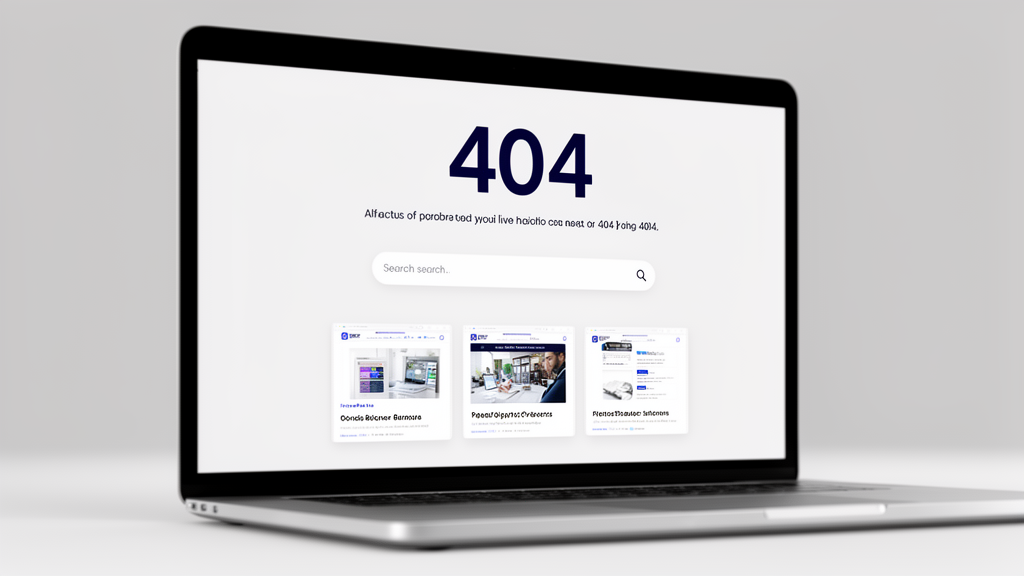
Consider the visual hierarchy. The error code should be prominent but not alarming. The message should be clear: “We couldn’t find that page.” The primary call to action should be relevant to the broken URL. The secondary call to action should be a general site resource, such as a search bar or a link to your most popular content. Do not bury the primary action under generic links.
Use humor sparingly and only if it aligns with your brand. A clever illustration can defuse frustration, but it should never distract from the primary goal of helping the user find what they need. If your brand is serious and B2B, skip the jokes. If your brand is playful and consumer-facing, a well-placed pun can humanize the error and make the user more forgiving.
Technical Implementation Without the Overhead
You do not need a dedicated engineering team to build an intelligent 404 page. Most modern static site generators and headless CMS platforms support custom 404 pages with server-side logic. If you are using a traditional CMS, you can implement this with a simple plugin or a few lines of server configuration.
The core logic is straightforward:
- Parse the requested URL.
- Extract keywords from the path.
- Map those keywords to your most relevant content using a simple database lookup or a predefined mapping file.
- Display the relevant content alongside the error message.
- If no match is found, display a generic but helpful fallback with a search bar and links to your top three pages.
This logic can be implemented in under 50 lines of code. It does not require machine learning or complex algorithms. It requires a clear understanding of your content structure and a willingness to treat 404 errors as a data source rather than a failure.
Monitor your 404 logs regularly. They are a goldmine for understanding what your users are looking for but cannot find. If you see a spike in 404s for a specific keyword, it means you have a content gap. Create that content, link to it from your 404 page, and close the loop. Your 404 page becomes a living map of your users’ unmet needs.
When a 404 Page Is Not the Answer
There are exceptions. If the broken link points to a page that has been permanently removed due to legal, compliance, or strategic reasons, do not redirect the user to alternative content. In those cases, a clear, direct message explaining why the content is gone is more appropriate. Misleading users with irrelevant content erodes trust faster than a simple error message.
Similarly, if the broken link is the result of a malicious attack or a spam campaign, do not engage. Block the source and serve a standard error page. The intent-matching principle applies to legitimate users seeking information, not to bad actors trying to exploit your site.
The 404 page is not a place to hide your mistakes. It is a place to demonstrate your competence. Every broken link is a test of your system’s resilience. Every recovered visitor is a vote of confidence in your ability to handle failure gracefully. Treat your 404 page as the salesperson it is, and it will pay for itself in recovered revenue, improved trust, and a more resilient site.