
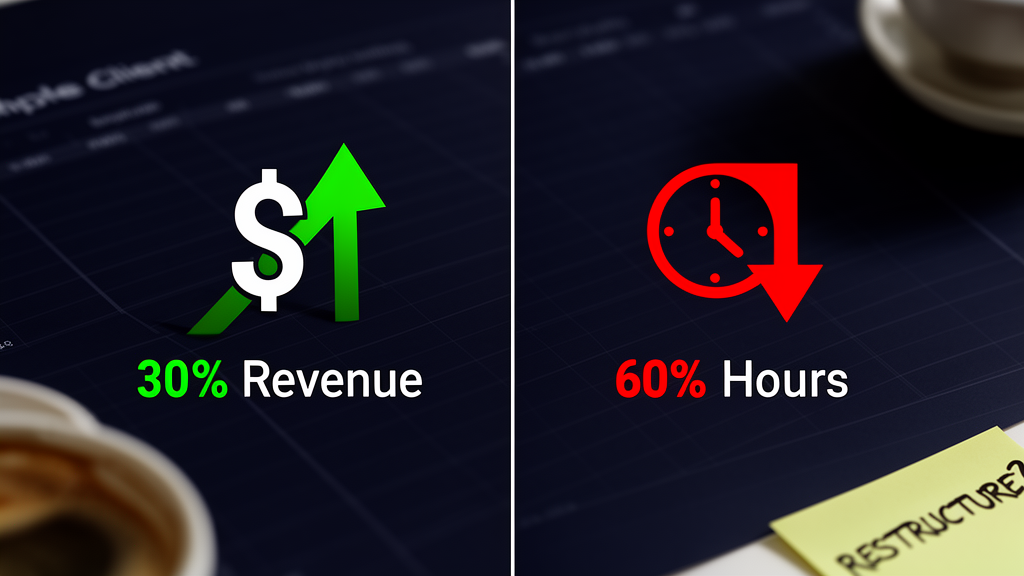
In 2019, a boutique marketing agency in Austin tracked every billable hour across 14 active clients for a full fiscal year. One client accounted for 34% of their total revenue, yet consumed 58% of the senior team’s actual working hours. The agency owner, a seasoned operator, looked at the spreadsheet and realized she was subsidizing her best clients with the labor required to manage the most expensive one.
Everyone tells you to fire your worst customers. That advice is structurally wrong for exactly 30% of the people reading it. When your single most difficult client is generating 30% or more of your revenue, firing them does not free up capacity. It removes the profit that keeps your other, easier clients profitable. The decision to let a client go is not a moral judgment. It is a math problem involving three variables: revenue share, hours consumed, and the margin of the remaining portfolio.
The 30% Revenue Threshold
Most freelancers and small agencies operate on a simple heuristic: if a client is difficult, fire them. The heuristic assumes that all clients generate roughly the same profit per hour. That assumption breaks down the moment a single account crosses a specific revenue threshold.
Track your revenue by client for the last 12 months. Identify the client generating the highest dollar amount. If that single account represents 30% or more of your total revenue, you have crossed the threshold where firing them becomes a capital decision, not an operational one.
At 30%, the difficult client is no longer just a bad hire. They are the financial engine subsidizing your entire operation. If you fire them, you do not get your time back. You lose the margin that allowed you to offer competitive rates to your easier, lower-maintenance clients. The math dictates you must either restructure the relationship or accept a 30% reduction in your baseline profitability.
The Hours vs. Revenue Mismatch
Revenue percentage is only half the equation. The second variable is the actual hours consumed. This is where the 30% rule gets nuanced, and where most operators make the fatal error of cutting a lifeline.
Calculate the ratio of hours worked to revenue earned for your top client. Compare that ratio to your average ratio across all other clients. If the top client’s ratio is worse than your average by more than 15%, you are losing money on every hour spent beyond a certain point.
Here is the practical test. If your top client generates 35% of your revenue but consumes 60% of your team’s hours, you are actively losing money on the remaining 65% of your portfolio. The profit from the top client is being diluted by the sheer volume of work required to service them. In this scenario, firing the client is the correct mathematical move, even if it takes your total revenue down by a third. You are trading dead weight for actual margin.
Conversely, if the top client generates 35% of your revenue and consumes only 30% of your hours, you have found a unicorn. This client is highly efficient, highly profitable, and highly valuable. Do not fire them. Negotiate a rate increase, lock in a longer contract, and protect this relationship at all costs.
The Three Scenarios That Actually Exist
When you run the numbers, exactly three scenarios will appear. Recognizing which one you are in removes the emotional weight from the decision and replaces it with a clear action plan.
Scenario A: The High-Revenue, Low-Effort Client. This client pays well, pays on time, and requires less than 25% of your team’s hours. This is your anchor account. Fire them, and you collapse your revenue base. Your action is to renegotiate upward. Bring the rate to market value, secure a 12-month commitment, and build a case study around their success. This client is the reason you can afford to take risks on smaller accounts.
Scenario B: The High-Revenue, High-Effort Client. This is the 30% problem. They pay the most, but they demand the most. They have scope creep, late-night Slack messages, and a refusal to sign off on deliverables. This client is destroying your margins. Your action is to restructure. Raise the price by 40% to cover the extra hours, or reduce the scope to fit the current price. If they refuse both, fire them. Accept the 30% revenue drop, but keep the 70% of your time. You will be more profitable, even with less total revenue.
Scenario C: The Low-Revenue, High-Effort Client. This is the classic “bad customer.” They pay a fraction of your top account, but they consume 40% of your hours. This is the easiest decision in the world. Fire them immediately. Do not overthink it. They are a net drain on every metric that matters. Your time is worth more than their invoice.
How to Execute the Decision
Running the numbers is the easy part. Executing the decision requires a specific communication framework, especially when the client in question is your top revenue generator.
Do not fire them via email. Do not send a vague notice citing “strategic direction.” Send a formal letter of termination, delivered by phone call, followed by the written notice. The letter should cite the specific reasons tied to the contract: missed milestones, repeated scope violations, or failure to adhere to the communication protocol. Do not get emotional. Do not apologize. State the facts, state the effective date (usually 30 days out), and state the final deliverables.
If you are restructuring a high-revenue client, the conversation is different. You are not firing them; you are changing the terms. “We value this partnership, but our current pricing structure no longer reflects the scope of work required. We are introducing a new rate card effective next quarter.” Most difficult clients will accept a rate increase because it buys them predictability. If they walk, you have your answer: they were never going to pay for the volume of work they were consuming.
The 30% rule forces you to stop treating every client as an equal. Some clients are liabilities disguised as revenue. Some are the silent engines of your business. The math will tell you which is which. Stop guessing. Run the numbers. Then make the decision your P&L demands.