
Youve spent twenty minutes crafting the perfect prompt for your AI writing assistant. Youve fed it context, tone instructions, a sample of your voice, and a clear task. The output is generic, stiff, and sounds like every other AI-generated blog post. You delete it, start over, and repeat the cycle. The problem isnt your prompt. Its your workflow.
Most people treat AI writing tools as a drafting engine. They paste a prompt, get a draft, and edit the result. That workflow guarantees robotic output, because the AI has no constraints beyond what you type in that single prompt. The fix is a pattern that forces the AI to do the heavy lifting before you ever see a draft: the prompt library pattern. Instead of writing prompts for every single task, you build a reusable library of structured instructions, then swap in the specific context for each project. The AI gets consistent guardrails, you get output that actually sounds like you, and you stop wasting twenty minutes on every single prompt.
Why Prompt Templates Fail Before You Start
AI writing tools sound like AI because you are using them backward. You are asking the tool to generate a finished product in one shot, without any structural constraints. The tool has no memory of your voice, no understanding of your audience, and no way to know what “good” looks like for your specific use case. It guesses. It guesses based on the most common patterns in its training data, which are the most generic patterns in existence.
When you write a prompt like “Write a blog post about time management,” the AI pulls from millions of blog posts about time management. It outputs the most statistically probable sentences. It uses phrases like “in todays fast-paced world,” “unlock your potential,” and “game-changing strategies.” It sounds like AI because it is pulling from the lowest common denominator of the internet.
The prompt library pattern fixes this by separating the structural instructions from the specific task. You build a library of prompts that define the rules, the tone, the format, and the constraints. Then, for each project, you only fill in the specific context: the topic, the audience, the goal. The AI follows the rules, not the statistics. It outputs something that sounds like you, because you defined what “you” sounds like in the library, not in the moment.
How to Build a Prompt Library That Actually Sticks
Building a prompt library sounds like extra work. It is. But it is the kind of extra work that saves you hours every week. The key is to build it once, test it, and never touch it again unless your voice or your audience changes. Here is the exact structure.
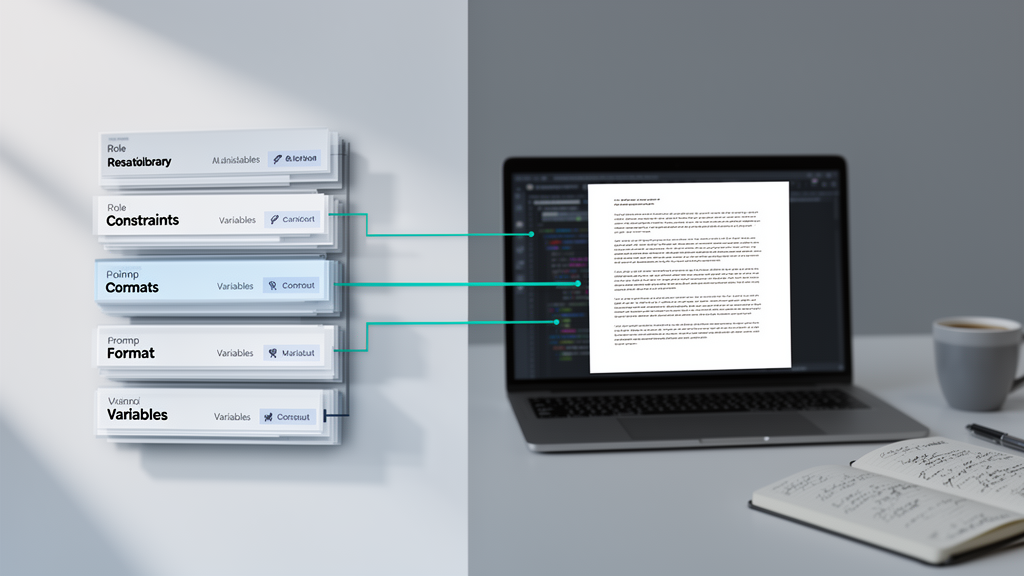
Start with a single document. It can be a Notion page, a Google Doc, a plain text file, or a dedicated prompt library tool. The format does not matter. The structure does. Every entry in your library needs four fields: the role, the constraints, the format, and the variables.
The role defines who the AI is pretending to be. Not “an AI assistant,” but “a senior editor at a B2B SaaS publication.” The constraints define what the AI cannot do. “No buzzwords. No passive voice. No more than 150 words per paragraph.” The format defines what the output looks like. “A headline, a three-sentence hook, five subheadings, a conclusion.” The variables are the only things you change for every project. The topic, the audience, the goal, the call to action.
When you fill in those variables, the AI follows the rules you wrote. It does not guess. It executes. The output is consistent, it is on-brand, and it requires editing, not rewriting.
The Prompt Library Pattern in Action
Lets say you run a freelance copywriting business. You need to write a blog post every week. Without a prompt library, you write a prompt like this: “Write a blog post about how to use AI for copywriting. Keep it professional but conversational.” The AI outputs a generic post about AI and copywriting. It uses phrases like “leverage AI” and “streamline your workflow.” It sounds like every other AI-generated blog post.
With a prompt library, you write this: “You are a senior copywriter with ten years of experience writing for small business owners. Your tone is direct, practical, and slightly cynical about marketing fluff. You never use the words leverage, streamline, or game-changing. You write in short paragraphs, no more than 150 words. You always start with a concrete example, then explain the principle, then give the reader one thing to do. The topic is how to use AI for copywriting. The audience is freelance writers who are tired of sounding like robots. The goal is to get them to try the prompt library pattern. The call to action is to download the template.”
The output is different. It sounds like you. It uses your voice. It follows your rules. It requires editing, not rewriting. And you spent five minutes writing the prompt, not twenty.
When the Prompt Library Pattern Fails
The prompt library pattern is not a silver bullet. It fails when your audience changes faster than your library. If you are writing for a completely new market, you need to write a new library entry. It fails when the task is highly creative, like writing a poem or a brand story, where constraints kill the output. It fails when you are brainstorming, because brainstorming requires open-ended exploration, not structured execution.
The pattern works best for repetitive, high-volume tasks: blog posts, email sequences, social media captions, product descriptions, case studies. If you are doing the same type of writing more than three times a month, build a library entry. If you are doing it once a year, skip it. The library is a tool for scale, not a replacement for thinking.
How to Maintain Your Library Without Burning Out
Most people build a prompt library, use it for a month, and then abandon it. They say it takes too long to update. The reason it fails is that they treat the library like a living document. It is not. It is a static reference. You build it, test it, and then you only update it when your voice or your audience changes. Not when you feel like it.
Set a quarterly review. Three times a year, look at your library entries. Are they still producing output that sounds like you? Are they still saving you time? If yes, leave them alone. If no, rewrite them. That is it. You do not need to tweak them every week. You do not need to add new entries every month. You build them, you test them, you leave them alone. The library is a tool, not a hobby.
The One Thing to Do Tonight
Open a document. Write one library entry for the task you do most often. Fill in the role, the constraints, the format, and the variables. Test it. If the output sounds like you, save it. If it does not, tweak the constraints. Do not build the whole library tonight. Build one. Test it. Save it. Tomorrow, build another. In a month, you will have a library that saves you hours every week. In a year, you will have a system that scales your output without scaling your effort.
The prompt library pattern is not a prompt. It is a system. It is the difference between using AI as a drafting engine and using it as a constraint engine. The draft is not the product. The output is. And the output is only as good as the constraints you gave it.