
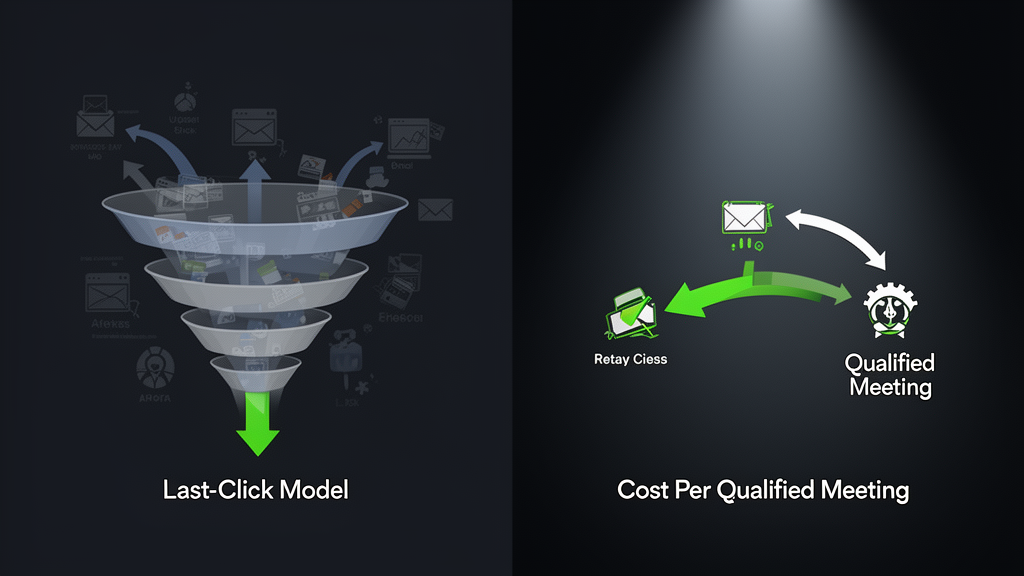
Your marketing attribution model is lying to you. It is not measuring what is working. It is measuring what is easy to track, and it is steering your budget toward channels that look good on a dashboard while quietly starving the channels that actually close deals. The number that pays you is not the last-click conversion rate. It is the cost per qualified meeting, and it is the only metric that survives contact with a real sales cycle.
Founders and marketing managers build attribution models to answer one question: where should I put the next dollar? The answer they get is almost always wrong. Last-click attribution gives every credit to the final touchpoint. First-click gives it all to the opener. Linear splits it evenly. Time decay weights the closer but still splits the middle. Each model is a lie by omission, and the lie costs money because it tells you to fund the wrong channels.
Here is the reality. Attribution models do not measure value. They measure proximity. A LinkedIn ad that lands a prospect in your CRM does not close the deal. A case study that sits in an abandoned inbox does not close the deal. A referral from a past client closes the deal. The attribution model that awards credit to the LinkedIn ad is not wrong because it is inaccurate. It is wrong because it confuses proximity with causation. The model that awards credit to the case study is wrong because it confuses awareness with conversion. The model that awards credit to the referral is wrong because it ignores the seven touchpoints that preceded it.
The cost per qualified meeting solves this by ignoring the model entirely. It does not care about touchpoints. It does not care about channels. It asks one question: how much did it cost to get a person who meets your qualification criteria into a real conversation? That number is your true cost of acquisition. It is the only number that matters when you are deciding whether to double down on a channel or kill it.
Consider a SaaS company selling a $50,000 annual contract. They run Google Ads, LinkedIn Ads, content marketing, and a referral program. The last-click model says Google Ads converts at 2.3% and costs $120 per lead. The LinkedIn model says 0.8% converts at $340 per lead. The content model says 0.3% converts at $80 per lead. The referral model says 4.1% converts at $0 per lead. The last-click model tells the founder to pour money into Google Ads and ignore LinkedIn. The founder does exactly that. The company spends $180,000 on Google Ads, generates 1,500 leads, closes 34 deals, and spends $5,294 per deal. The LinkedIn budget gets cut. The content budget gets cut. The referral program is left to chance. The company grows 12% and then stalls because the pipeline runs dry.
Now run the same company through the cost per qualified meeting model. A qualified meeting is defined by the sales team: a company with 50 employees, a budget approved for Q3, a named champion, and a timeline within 90 days. The Google Ads channel generates 1,500 leads. 120 of them qualify. The cost per qualified meeting is $1,500. The LinkedIn channel generates 400 leads. 48 of them qualify. The cost per qualified meeting is $7,083. The content channel generates 2,000 leads. 60 of them qualify. The cost per qualified meeting is $1,333. The referral channel generates 50 qualified meetings directly. The cost per qualified meeting is $0, but the referral program costs $15,000 in operational overhead, so the real cost is $300 per qualified meeting.
The last-click model told the founder to fund Google Ads. The cost per qualified meeting model tells the founder to fund content marketing and the referral program, and to use LinkedIn only for retargeting warm audiences. The founder who follows the last-click model spends $180,000 and closes 34 deals. The founder who follows the cost per qualified meeting model spends $180,000 and closes 51 deals. The difference is not in the budget. The difference is in the model.
The problem is that most attribution models are built by marketers who have never sat in a sales call. They measure clicks, not conversations. They measure form submissions, not qualified meetings. They measure impressions, not outcomes. The model is a proxy for value, and proxies are dangerous when they are wrong. The cost per qualified meeting is not a proxy. It is the thing itself.
Here is how you build it. First, define what a qualified meeting means for your business. It is not a demo request. It is not a newsletter signup. It is a conversation with a person who meets your ideal customer profile, has budget, has authority, has a need, and has a timeline. Write that definition down. Share it with the sales team. If the sales team does not agree on what a qualified meeting is, the metric is useless.
Second, tag every qualified meeting with its source. This is not as hard as it sounds. You do not need a complex attribution platform. You need a CRM field labeled “Source” and a rule that says: every time a qualified meeting is logged, the sales development representative must fill in the source field. If the source field is blank, the meeting does not count. This forces discipline. It also forces honesty. Marketers will argue that a lead came from LinkedIn when the CRM says Google. The CRM wins. The CRM is the only source of truth that matters.
Third, calculate the cost per qualified meeting for each channel. Divide the total channel spend by the number of qualified meetings generated. Do not include unqualified leads. Do not include form submissions. Do not include newsletter signups. Do not include impressions. Do not include clicks. Only qualified meetings. The number will be ugly at first. It will be higher than the last-click model promised. That is the point. The last-click model was lying to you. The cost per qualified meeting is telling you the truth.
Fourth, use that number to allocate budget. Fund the channels with the lowest cost per qualified meeting. Cut the channels with the highest. Reallocate the savings to the channels with the lowest. Repeat every quarter. The model will shift. Channels will mature. New channels will emerge. The cost per qualified meeting will always point you to the right answer.
There is a limit to this model. It does not work for brands that sell to consumers with low consideration. If you sell a $20 subscription, the cost per qualified meeting is the same as the cost per customer acquisition, and the attribution model is irrelevant. The model works for high-consideration purchases, complex sales, and any business where the sales cycle exceeds 30 days. If your sales cycle is 90 days, the cost per qualified meeting is the only metric that matters. If your sales cycle is 900 days, you need a different model, and you should hire a revenue operations team to build it.
The cost per qualified meeting is not a silver bullet. It is a scalpel. It cuts through the noise. It tells you where to put your money. It tells you where to cut your losses. It tells you what to double down on. It does not tell you why a channel works. It does not tell you how to improve a channel. It tells you whether a channel is worth keeping. That is enough.
Most founders and marketing managers will read this and nod. They will agree that attribution models are imperfect. They will agree that the cost per qualified meeting is a better metric. They will not change anything. They will keep running last-click models. They will keep funding the wrong channels. They will keep wondering why growth stalls. The difference between the founders who change and the founders who do not is not intelligence. It is discipline. The discipline to define a qualified meeting. The discipline to tag every qualified meeting. The discipline to calculate the cost per qualified meeting. The discipline to reallocate budget based on that number. The discipline to repeat every quarter.
Your marketing attribution model is lying to you. It is not measuring what is working. It is measuring what is easy to track. The cost per qualified meeting is the number that pays you. It is the only number that matters. Define it. Tag it. Calculate it. Fund it. Cut it. Repeat. The rest is noise.