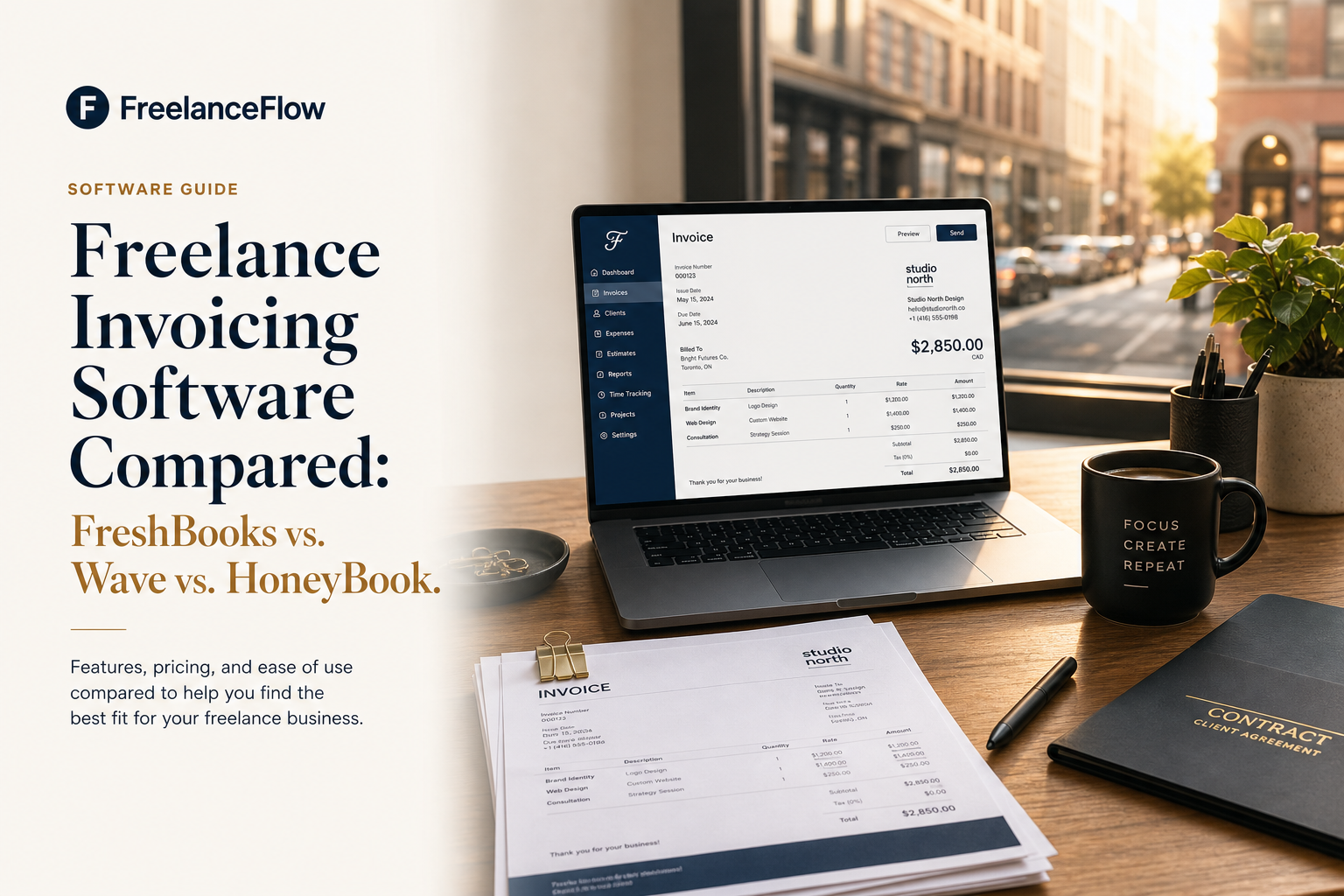
Freelance invoicing software should be the least stressful part of running a solo business. Send a professional invoice, get paid, move on. But the three tools that dominate this category — FreshBooks, Wave, and HoneyBook — are built around very different ideas of what a freelancer actually needs, and picking the wrong one costs more than money.
Here is the honest breakdown of all three: what they do well, where they fall short, and who each one is genuinely built for.
Why Invoicing Software Is Not Interchangeable
Most freelancers reach for whichever tool a forum post recommended and never look back. That works until it doesn’t. You hit the client limit on a free tier, need a contract built into the payment flow, or discover that “free” actually means 2.9% + 30¢ on every transaction — which adds up to real money once you cross $3,000 a month in billings.
The right framework before comparing tools: decide whether your core problem is accounting, client experience, or cash flow visibility. Each tool optimizes for a different one of those three things, and that determines almost everything else.
FreshBooks: Built for Billing at Scale
FreshBooks started as a simple invoice-builder and has grown into something closer to a lightweight accounting platform. It handles recurring invoices, automated payment reminders, time tracking, project profitability reporting, and double-entry accounting — without requiring you to understand what double-entry accounting actually is.
Pricing runs from $19/month (Lite, up to 5 clients) to $55/month (Premium, unlimited clients), with a Plus tier at $33/month that covers most solo operators up to 50 active clients. There is no free tier.
Where FreshBooks earns its fee is automation. You can set a late-payment reminder schedule once and never think about it again. Recurring retainer invoices go out on schedule, get tracked, and feed directly into expense reports. If you send more than 10 invoices a month and bill hourly, the time-tracking integration alone pays for the subscription.
The weak point is the client cap on lower tiers. If you do project-based work with many smaller clients, the 5-client Lite limit will frustrate you within months. Jumping to Plus at $33/month is usually the right call from day one.
Best for: Freelancers billing hourly, consultants on retainer, or anyone with 5+ recurring clients who wants accounting to run on autopilot.
Wave: Actually Free, With a Real Catch
Wave’s headline is that invoicing, accounting, and receipt scanning are completely free. That is true. Wave makes its money on payment processing, charging 2.9% + 30¢ per card transaction (3.4% + 30¢ for American Express) and 1% for bank transfers (minimum $1). Payroll is also a paid add-on at $20/month plus $6 per active employee.
For freelancers who collect most payments via bank transfer, Wave is genuinely hard to beat. The invoicing interface is clean, the double-entry accounting is solid for a free product, and the reporting gives you a clear picture of income versus expenses without requiring a paid upgrade.
The problem arrives when clients prefer paying by card. At $5,000/month in billings, 2.9% means you are paying $145/month in processing fees — more than FreshBooks charges for its top tier. Wave is free software with a payment-processing business model underneath it, and that model works against you once volume climbs.
Wave also lacks native contract management, project tracking, and client portals. If your workflow is purely “send invoice, accept payment, record expense,” that is fine. If you need anything adjacent to project management, you will be stitching together additional tools.
Best for: Freelancers just starting out, those who primarily invoice via bank transfer, or anyone who needs solid free accounting and doesn’t mind managing contracts elsewhere.
HoneyBook: The Client Experience Tool That Also Invoices
HoneyBook approaches the problem from the opposite direction. It is not primarily an invoicing or accounting tool. It is a client relationship platform — proposals, contracts, invoices, questionnaires, and scheduling — that happens to include payment collection. That distinction matters.
Pricing is $19/month (Starter, with a cap of $10,000 in annual payments processed) or $39/month (Essentials, unlimited) or $79/month (Premium, with additional automation tools). A meaningful detail: the Starter plan caps revenue processed, not clients, which makes it genuinely usable for new freelancers billing smaller amounts.
The standout feature is the client-flow pipeline. You can send a branded proposal, have the client sign a contract and pay a deposit in a single link, and then trigger follow-up questionnaires automatically. For photographers, event planners, designers, and copywriters who deal in project-based client relationships, this replaces three or four separate tools (HelloSign or DocuSign for contracts, Calendly for scheduling, a separate invoicing tool) with one workflow.
What HoneyBook is not is an accounting system. There is no proper general ledger, no bank reconciliation, and the reporting is lightweight. Most HoneyBook users export income data to QuickBooks or a spreadsheet at tax time. If you need to track expenses, run payroll, or produce a real profit-and-loss statement, you will need a companion tool.
Best for: Creative freelancers and service providers (photographers, designers, event professionals, coaches) who need a polished client experience end-to-end, not just a billing tool.
Side-by-Side Comparison
FreshBooks
Wave
HoneyBook
Starting price
$19/mo (5 clients)
Free
$19/mo ($10k cap)
Payment processing
2.9% + 30¢ (cards)
2.9% + 30¢ (cards), 1% ACH
2.9% + 25¢ (cards), 1.5% ACH
Contract management
No
No
Yes (built-in)
Time tracking
Yes (built-in)
No
No
Double-entry accounting
Yes
Yes
No
Automated reminders
Yes
Basic
Yes
Client portal
Limited
No
Yes (full)
The “Free” Math Problem Every Freelancer Should Run
Before defaulting to Wave because it costs nothing, do this calculation. Take your average monthly billings, multiply by 0.029, and add $0.30 per invoice. That is your effective monthly cost if clients pay by card. At $4,000/month in revenue, you are paying roughly $116 in processing fees — and FreshBooks Plus at $33/month is suddenly the cheaper option, even before accounting for the time you save on its automation features.
Wave is genuinely the right call for freelancers below ~$2,500/month in card payments, or for anyone who can reliably push clients toward ACH bank transfers. Above that threshold, the free tier starts costing you more than a paid alternative.
This same math applies to HoneyBook’s Starter plan. The $10,000 annual payment cap sounds generous until you realize that for a $39,000-per-year freelancer, you will hit it by the end of March.
Making the Right Call for Your Setup
If you need to send invoices, track billable hours, and want real accounting without hiring a bookkeeper: FreshBooks. Start on Plus at $33/month and use the time-tracking integration from day one.
If you are early-stage, billing under $2,500/month, and mostly collect via bank transfer: Wave. You get solid accounting for free, and you can always migrate later when your volume justifies a paid platform.
If your business lives and dies by client relationships — proposals, contracts, deposits, onboarding questionnaires — and you are in a creative service vertical: HoneyBook at $39/month. Accept that you will use a separate tool for full accounting at tax time.
For a broader look at the tools that keep a solo operation running smoothly, this guide to organizing your small business covers complementary software across CRM, project management, and file storage.
None of these tools fail at their core job. The mistake is picking one for the wrong job. A freelance photographer running HoneyBook for accounting is going to be frustrated. A consultant using HoneyBook because it “looks nice” is paying $39/month for features they never open. Match the tool to the actual constraint in your business, not to what another freelancer in a different vertical swears by.
Frequently Asked Questions
Can I switch invoicing software without losing my billing history?
All three tools let you export invoice history as CSV files. FreshBooks and Wave also support full accounting data exports. Migrating mid-year is messier than migrating at the start of a tax year, but it is not catastrophic as long as you export before cancelling.
Do any of these tools handle sales tax automatically?
FreshBooks and Wave both support tax rate configuration on invoices, but neither automatically determines the correct rate based on your client’s location. For US freelancers with multi-state clients, you will still need to manage nexus rules manually or use a dedicated tool like TaxJar.
Is HoneyBook a replacement for QuickBooks?
No. HoneyBook is a client management and billing platform, not an accounting system. Most HoneyBook users connect it to QuickBooks via integration or export income reports manually at tax time. If you need a full general ledger, HoneyBook is not built for that.
Which tool has the best mobile app?
FreshBooks has the most complete mobile experience, including time tracking, expense capture, and invoice sending from the app. Wave’s mobile app handles receipt scanning well but is limited on the invoicing side. HoneyBook’s app covers proposals and client communication but is not designed for on-the-go accounting.